How you sound, written down.
Sound like someone, because most businesses now sound like anyone.
A Wordprint is a brand voice guide built from evidence rather than adjectives: a written specification of how your business actually sounds, taken from what you have already published, that a new hire, an agency, or ChatGPT, Claude, Copilot and Gemini can all follow.
It has three readers. You, when you are stuck on a paragraph and one of the rulings matches. Anyone writing on your behalf, who can produce a passable draft from it without ever having met you. And your software: the last section is a prompt pack that goes into ChatGPT, Claude, Copilot or Gemini, so the drafts come back right and you stop being the last check.
The Anyone Test asks one question: could anybody have written this? A minute, no account, and it runs in your browser, so nothing you paste is sent anywhere.
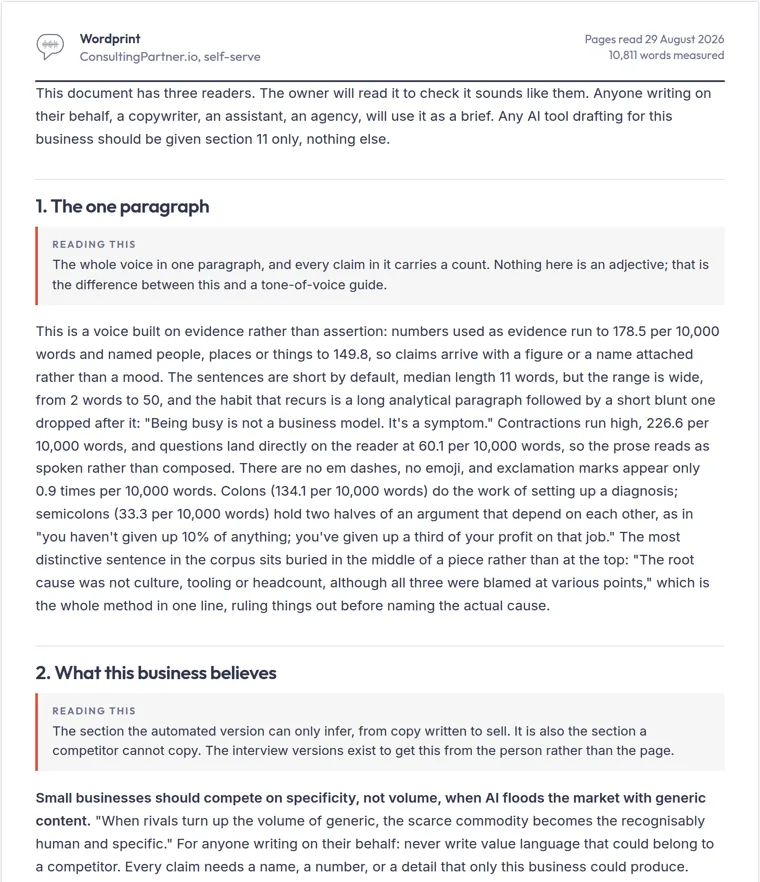 A Wordprint, page one of fifteen. Read one in full →
- 22things measured on every page
- 4that separate a voice from the average
- 6businesses in five sectors the method was built on
- 168firms in five sector benchmarks, nobody named
Start here, free, one minute
Someone, or anyone?
Every sentence you publish falls into one of two piles. Some of it could only have come from your business: a specific number, a refusal, an opinion a competitor would argue with. The rest could have been written by anybody, for anybody, and a fair amount of it now comes out of a tool that has never met you.
The test does not know or care which of those produced any given sentence, and neither does the person reading it. Most businesses are drafting with assistance now. That is not the problem. What the assistance defaults to is.
Anyone could have written this
"We deliver tailored solutions that drive real business value for our clients."
No number, no opinion, nothing a competitor would dispute.
Only one business could
"We price the job, not the hour. Hourly billing rewards slowness and punishes tidiness."
A position somebody could disagree with, in plain words.
Paste something you have published. The Anyone Test names what is generic, quotes back the sentences that are genuinely yours, and gives you one thing to fix. It never rewrites a word for you.
Nothing you paste leaves your browser. There is no server call, no account and no email address. The code runs on your own machine, so an unpublished draft is safe to put in the box.
The problem
Sounding like everybody else is expensive
Fluency used to be the hard part, and the businesses that had it stood out. That advantage is gone. It is not coming back.
What replaced it is a peculiar sameness. Not bad writing. Competent, tidy, unobjectionable writing that could belong to any of your competitors, because it was assembled from the same stock as everybody else's.
AI is a superb instrument and a hopeless author. Give it a blank page and it returns the average of everything ever written, which is precisely what you do not want.
Nobody writes in to say your site reads like the other four they opened this morning. It shows up as three costs instead.
You get compared on price. When a buyer cannot tell two suppliers apart on anything else, they fall back on the number.
Trust arrives slower. People buy from businesses that sound like they are run by somebody. Anonymous competence reads as a front, and a front has to be checked.
Everything needs your personal rewrite. This is the one that hurts. Five people write for the business and produce five voices, the tools they use produce a sixth, and the only quality control is you reading all of it. That is a bottleneck with your name on it, and it gets worse every time somebody discovers a faster way to produce a draft.
All three have the same cause, and it is not a shortage of talent. The rules exist. They are in somebody's head and they have never been written down. Write them down and the price comparison, the slow trust and the rewriting queue go with them. Whatever you are paying the people and the software writing in your name, you are paying it again next month. You pay for this once.
Is this you, this month?
The moment it stops being theoretical
Somebody new is writing for you
A hire, an agency, an assistant. They do not know how you sound, so you rewrite what they produce and you both know it is happening.
Something new is writing for you
The team drafts in ChatGPT now, or Copilot arrived inside software you already had. Output went up. Distinctiveness went down. And the same tool is drafting for your competitors from the same average, so whatever it defaults to is theirs as much as yours.
Two voices have to become one
A rebrand, a merger, a sub-brand. Somebody decides whose habits survive, and left alone that is whoever writes fastest.
You have become the bottleneck
Everything published waits on your desk. You cannot hand that to anybody until the rules exist somewhere other than your head.
Your competitors have got louder and you are being crowded out
They have not got better. They have got faster. Matching their volume with the same tools and no specification just produces more of the same average, and arguing you are different while publishing what everybody else publishes is a losing position.
Distinctiveness and volume only compete while the rules live in one person's head. Written down, they stop competing: the specification is what lets you publish four times as much and still sound like nobody else. Start by measuring how far apart you actually are: here is a Soundalike, read in full.
None of those is a job title, which is deliberate. What predicts this is a moment rather than a market: a writer arrives, a tool arrives, two things merge, one person runs out of evenings, or the market gets louder around you.
Where the software stops, and this is the part that matters
Where the software stops
The test will take you as far as knowing you have a problem, and one step no further. That is deliberate, and it is worth being honest about why.
Software can count. It can tell you that every sentence is the same length, that eleven phrases came out of the category phrasebook, and that your best line is buried three screens down. It cannot tell you what you believe, which of your habits are worth keeping and which are accidents, or what to say to a client who does not want to hear it.
One subject's writing was strong in the first half of the page and flat in the second. The measurements found the drop and put a figure on it: sentence variance fell from 10.8 in the first half to 6.2 in the second. What they could not say, and what took a person, was the reason: the writing changes costume when it starts describing services, and the fix was not to rewrite the services but to write them in the voice of the origin story.
This is the whole of the argument, and it is why there are three stages rather than one product. Software finds the problem. A person decides what to do about it. Then somebody has to make the answer stick when neither of us is in the room.
Most businesses stop after the first stage and fix a few phrases, which is a perfectly good outcome and costs nothing. The second is for the ones who want it to hold when they are not the one writing.
If you only buy one thing
A Desk Wordprint, £950
Everything your business publishes sounds like your business, whoever wrote it and whatever wrote it.
Built from what you have already published, with no interviews and nothing for you to prepare. Send a link. Five working days later you get the specification: what you believe, the rhythm your sentences actually run at, the phrases that are yours, the ones that are everybody's, the awkward cases with rulings, and a prompt pack that goes straight into whatever software your team already uses.
- Five working days, and the date is fixed before anything starts.
- Nothing to prepare. No workshop, no questionnaire.
- Written by a person, from evidence a machine counted.
- Yours to hand to anybody who writes for you, including the software.
If it does not tell you at least three things you did not know about your own writing, you do not pay.
That promise is not bravado. Every business measured so far has turned up something its owner did not know, usually a habit nobody had ever written down, and it is a fair test of whether the thing is worth £950.
The products
Three questions. Start with the free one.
Find out whether you have a problem. Then write down the answer, either by software or by a person reading the evidence and ruling on it. That difference is the only thing separating the two paid options below. The Desk Wordprint is the one to buy: it is the one that carries the promise. The self-serve version is for a business that has already decided it wants the document without the ruling.
Built on six businesses in five sectors. Two of them are named on the About page with their scores.
The Soundalike, the self-serve Wordprint and the Desk Wordprint are priced exactly and paid by card when you order, and the Desk's delivery date is on the receipt. The interview versions are quoted from the figure shown and fixed in writing before anything starts. Either way the price quoted is the price: no VAT or sales tax is added.
Could anybody have written this?
The Anyone Test. Free
Could anybody have written this? Paste a page you have published and get a score in a minute. No account, nothing stored, nothing sent anywhere: it runs in your browser, not on a server.
Start here. If it says your writing is already distinctive, you have saved yourself a purchase.
How do we actually sound, written down?
Self-serve Wordprint. £395
Send a link, and the document arrives. Software reads what you have published, measures twenty-two things about it and writes the specification, and nobody rules on it. Fifteen pages or so at a permanent private link, printable as a properly laid-out PDF or exported as markdown. Read one in full. The part that earns its keep is the prompt pack: your specification in the form ChatGPT, Claude, Copilot and Gemini take instruction in, so every draft they produce starts from your voice.
Back inside two working days. It tells you accurately how you sound. It cannot tell you which of your habits is worth keeping.
And which of those habits is worth keeping?
Desk Wordprint. £950
The same measurements, then somebody with twenty years of proposals, bids, pitches, board papers and marketing behind them reads the evidence and rules on it. Which habit is a strength, which is a tic, and which sentence you keep trying to cut is the best one you have.
Five working days. No interviews, nothing to prepare, just a link. It is the judgement that the three-things promise rests on.
Everything else, with prices: the Soundalike, the Draft Clinic, the team session, the editor in residence, the portfolio report, Say It Once and the Check are on their own page. What is actually inside a Wordprint, if you want the detail before you spend anything.
Reasonable objections
The questions worth asking first
Starting with the one most people arrive with, and which deserves a straight answer rather than a defensive one.
Wait. Could I not just prompt ChatGPT to do this myself?
You can, and you should try it before you buy anything here. Paste your site into ChatGPT, Claude, Gemini or Copilot and ask it to describe your voice. It takes five minutes and it will give you something that reads well.
Then read what it gives you. It will be adjectives: professional yet approachable, authoritative but warm, clear and concise. Every one of those is true of your competitors too, which means none of them is a rule anybody can follow. Ask two different models and you get two different sets of adjectives, because there is nothing underneath either answer to make them agree.
The difference is not effort, it is evidence. A Wordprint counts twenty-two things about how you actually write: your median sentence length, how often you reach for a colon against a semicolon, whether you say I or we and at what rate, which words recur that recur nowhere else in your sector. Those numbers do not change between runs, and a rule built on one is a rule a new hire or a model can be held to. "Median sentence 11 words, longest 50, break a long build-up with something under five" is checkable. "Authoritative but warm" is not.
The second difference is judgement, and it is the one worth paying for. Software can tell you that you hedge four times per ten thousand words. It cannot tell you that three of those are fine and the fourth undermines the only paragraph that mattered. That is the part a person does.
Is this not just a style guide with extra steps?
A style guide is written before the fact and says what somebody wishes the writing were: use active voice, avoid jargon, be human. A Wordprint is written after the fact from what you have already published, and says what your writing demonstrably is.
The practical difference shows up when the two disagree. A style guide tells you your sentences are too long. A Wordprint tells you your longest recorded sentence is fifty words, that the long ones are where you stack evidence, and that flattening them would remove the thing that makes the argument land. One is a preference. The other is a measurement with a ruling attached.
What do I actually receive?
A document of roughly fifteen pages at a permanent private link that never expires, laid out to print as a proper PDF, and exportable as markdown to hand to anybody who writes for you. The part to lean on is the prompt pack: the specification compressed into the form ChatGPT, Claude, Copilot and Gemini take standing instructions in. Paste it once and every draft those tools produce for you starts from your voice rather than from a blank page. That is the key to the rest of your AI use, and the other fourteen pages exist to justify it.
Inside it: the one-paragraph description of your voice, the convictions your writing takes a position on, who you are speaking to and where the register shifts, the full measurements, your habitual moves with real quotations of each, what your voice will not do, generic-against-real rewrite pairs, rulings on the arguments you will actually have about your own writing, and an honest section on what the method cannot tell you.
Will it make everything I publish sound the same?
No, and it is the right worry. A specification that produced identical prose would have failed at the thing it exists to do.
It describes how you sound, not what you say, in the way a person's voice is recognisable across a complaint, a eulogy and a joke without those three being the same. The organisation Wordprint goes further and writes down how the register is allowed to shift between speaking roles, because a chief executive and a support desk should not sound identical and should still sound like the same company.
Does using AI to write this not defeat the point?
It would if the output were copy. It is not: the deliverable is a description of your own writing, built from your own writing, and nothing here ever generates prose for you to publish.
The position is pro-tool and anti-default. Everybody now drafts with a model somewhere in the loop, and left to itself every model reaches for the same middle. The answer is not to stop using them. It is to give them something specific enough that they stop guessing.
How is my writing handled?
The Anyone Test never leaves your browser: there is no account, nothing is stored and nothing you paste is sent to a server. For the paid products, the pages you point it at are read, measured, used to build your document and then deleted once it is delivered. Your writing is never used to train anything, and no client is named as a reference without asking first.
What if it tells me nothing I did not already know?
Then the Desk Wordprint is free. Three things you did not know about your own writing, or you do not pay, and you keep the document either way.
The automated version at £395 does not carry that promise, because the promise rests on a person having read your evidence and deciding what is worth telling you. It carries a narrower one: if the tool cannot read what you send it, or the document arrives incomplete or wrong about your business, you get your money back.
Where do I buy the Check?
You do not, from here. The Check belongs to a Wordprint, so it lives on the Wordprint's own page: every delivered document has a permanent private link, and the same link with /c/ in place of /d/ is the Check. It is free for the document's first ninety days, and after that the page offers £39 a month or £390 a year, paid to Stripe and cancelled from the receipt.
If the email with the link has gone, ask and it gets re-sent. An organisation Wordprint, with several speaking roles to hold a draft against, will carry the Check at £79 a month when that version is built; it is not yet.
I am not sure which one I need.
Start with the free test, which takes a minute. If it shows a problem worth fixing, the Desk Wordprint at £950 is the rung most people should buy: it is built from what you have already published, so there is nothing to prepare, and it carries the promise.
Go to the full Wordprint only when other people write in your name and need to get it right without asking you. If the honest answer is that you do not need any of this, that is what you will be told. It happens often enough to be worth saying out loud.
Start with the free test
You are one minute from knowing whether your writing could have come from anybody, and if it could, which specific habits are doing it.
If it tells you something you did not know, there is a conversation worth having. If it does not, you have lost a minute and learned that your writing, or your prompting, is in better shape than most of your market. Both are useful answers and only one of them costs anything.